
Read time – 05:00 Minutes
Coach Abhi’s disclaimer : The content written in this blog post is only for general information purpose, and not to be taken as medical advise. The reader is expected to use his or her common sense before using any of this information. I disclaim all responsiblity for any liability, loss or risk, which is incurred as a consequence of the use and application of any of the contents of this blog post.
This time of last year was spent tapering (completing the training) for the TCS World Open 10K. Little did we imagine a pandemic would bring the world of sport and recreation to a halt. I can imagine a world after the pandemic, where most of running events will have stringent rules making masks mandatory, or races being flagged off in waves of ten, or multiple events of the same race happening across different cities to prevent large gathering. Of course none of this may happen at all, and things may just be as good as before but it is my wishful thinking. Fact is things are not going to be the same, we must accept the new normal and move on. The TCS World 10K, Bengaluru which was supposed to be next week, has invited entry forms for their revised race day scheduled on the 22nd November. As much as I am eager to apply, I may have to skip this year. My personal goal this year was a sub 45:00 minute Open 10K. Skipping this year’s race is a hard decision I had to take, to undo the damage of the pandemic. (Life of an entrepreneur.) Personally, I run races (only two a year) for a particular goal finish time (the finisher medal feels a lot more deserving). My intention is giving my best effort, and be ranked as top runners across my age, and gender. When you run bigger races like the TCS World Open 10K out of the sixteen thousand odd participants it is good to know one’s place as being in merit top one hundred runners, and in smaller races top ten is good enough.
I am writing this blog post for those who want to run for a their best timing and not necessarily for those whose goal is to finish the race which most of you will by default. 10K races may not demand a longer or intense preparation as a half or a full marathon, but one cannot run races without training and a goal-mindset. Is it possible to set a realistic goal (finish time) for your very first 10K? It is possible to predict your 10K race timing if you have been consistently running your practice distances at a steady pace. If your practise pace (minutes per kilometre) is 06:30 min/km, it is likely that your 10K average race pace is five percent more than the practise pace. It takes regular practise (four months) of building up aerobic capacity to compete a 10K well under seventy minutes. (Assuming that you will be graduating to this distance from, say a 5K under 30:00.) If your priority is to just finish your first 10K, then it is not necessary to consider finish time. Running for better timings becomes important (again it depends on what you want) after running six races in a span of three years. One must spend time to build up the required cardio-respiratory fitness needed to endure the race distance and make the body adapt to handle distances exceeding race distances. (Remember the principles of SAID.)
Let us understand the methods to improve your overall running performance especially for longer distances like 10K. I am assuming that the reader wants to set a goal finish time and accordingly the suggestions have been recommended. Please note that these training methods have been consistently used by all runners across the long distance formats. Some of the athletes may be having a unique genetic make up to dominate long distance sports, nevertheless these training methods will definitely make anyone run long distances with ease and give a fair chance attempting to run races in their personal best timing. It is important to be consistent, listen to the body, cross-train for strength, watch out for signs of fatigue (over-training), plan nutrition and rest to assist recovery, and be pragmatic with the training program. Some important principles to keep in mind before training in a particular method is to understand that the 10K race demands almost 80% of the aerobic energy system, and 15% of anaerobic energy system (Lactic acid and ATP-CP energy system) and only a 5% of the ATP CP system. In other words one must train predominantly to develop the aerobic energy systems (running for duration exceeding thirty to forty minutes continuously in a sustainable pace), along with improving the anaerobic energy systems by running distances (like 400m, 800m) at a fairly sustainable intensity and once in a ten-day, sprints (60m – 100m) at high intensity. (I am simplifying this concept to keep the blog post suitable for all readers.) The following methods can be used in the overall training program to prepare your body for a 10K race –
- Long Slow Distance (LSD) or the Slow-Continuous Method
- Interval Training
- Fartlek or Speed play
- Repeats
- Sprints
If you are using a fitness tracker like Garmin, it will be useful to track your runs to check your practise runs are in the 70% of your HR Max. Without gadgets it is possible to check your HR using conventional methods of pulse count(for six seconds) x 10 seconds. To identify your aerobic training HR, use the following steps – Calculate your HR Max with a simple formula,
Max HR = 220 – Age
Example – For a 30 year old male runner, his Max HR = 220 – 30 = 190 bpm (beats per minute) 70% of the Max HR is 190 bpm x 70% = 133 bpm
So for that 30 year old it is recommended to run continuously for forty minutes or longer in the zone of 133 bpm to develop his aerobic capacity. There are other training formulae like, The Maffetone Method which can be used as you improve your proficiency of your runs, and aspire to take up longer distances after getting bored of 10K. I will leave it out of the scope of this post. Remember – some of the more conditioned runners may have a higher Max HR thresholds or other parameters as per their physiology.
To get a PB means to commit to a training program, and attempt sincerely to give one’s best effort. These are some of the things I do (have done) during my training/practise time to get a PB (following these habits can be rewarding on the race day) –
- Using minimum aid while running, hydration can be mistakenly overrated and can cost run time if one does not acclimatize to run without water breaks
- Pacing evenly by checking on your splits is a good way to breakdown the race distance, and check your speed variations
- Avoiding use of head phones, although this is an individual choice, small things can hamper performance or put you at risk as you are unaware of surrounding
- Learn to breathe in a 3:2 steps, exhale:inhale ratio to maintain your HR steady, invest quality time to train all the respiratory muscles using training aids, and special exercises
- Practise run terrain must be similar to the actual race, run on trail for trail run, on roads for a road race
- Wearing simple time keeping device like a stop watch with a countdown timer to set the goal finish time, this may be advisable after four races
- Having a basic understanding of nutrition including pre race preparations, strategies to load glycogen (using unconventional approach to diet/food can be experimented if the orthodox glycogen loading methods do not work for you)
- Experimenting with minimalist shoes (if you have a normal foot arch) in practise and switching over fancier shoes closer to the race week – this has always worked for me as I switch from a simple BATA canvas/Vibram Five Fingers to a Nike Pegasus
- Understanding the fact that mis-pacing is a real threat, and not to be carried away by runners who tempt you to run faster than you have trained for
- Integrating a strong leg and core strength routine, adding plyometrics (coaching needed) and maintaining body free of injuries by smart stretching
Yes there are going to be many more races to run, many more finisher medals to earn, but the fact that I am not a professional athlete and by occupation being a Coach/Entrepreneur (full-time), it is a hobby to run races to keep myself at par with the above-average runner’s fitness. As a recreational athlete I cannot afford to nor do I have the luxury of extra time to give my best efforts to this goal of getting a sub 45:00 Open 10K in the present situation of pandemic/recession crisis. I do not intend to set a goal and then leave it half way. So I have come to point where I am finding my weekend long runs just as satisfying as the race itself, I will keep running and hoping to get that PB next year. For now – it is not to run!
QUOTE THAT INSPIRED ME TO WRITE THIS BLOG POST –
“Every morning in Africa, a gazelle wakes up, it knows it must outrun the fastest lion or it will be killed. Every morning in Africa, a lion wakes up. It knows it must run faster than the slowest gazelle, or it will starve. It doesn’t matter whether you’re the lion or a gazelle-when the sun comes up, you’d better be running.” – Chirstopher McDougall author of Born to Run : A Hidden Tribe, Superathletes, and the Greatest Race the World Has Never Seen (2009)
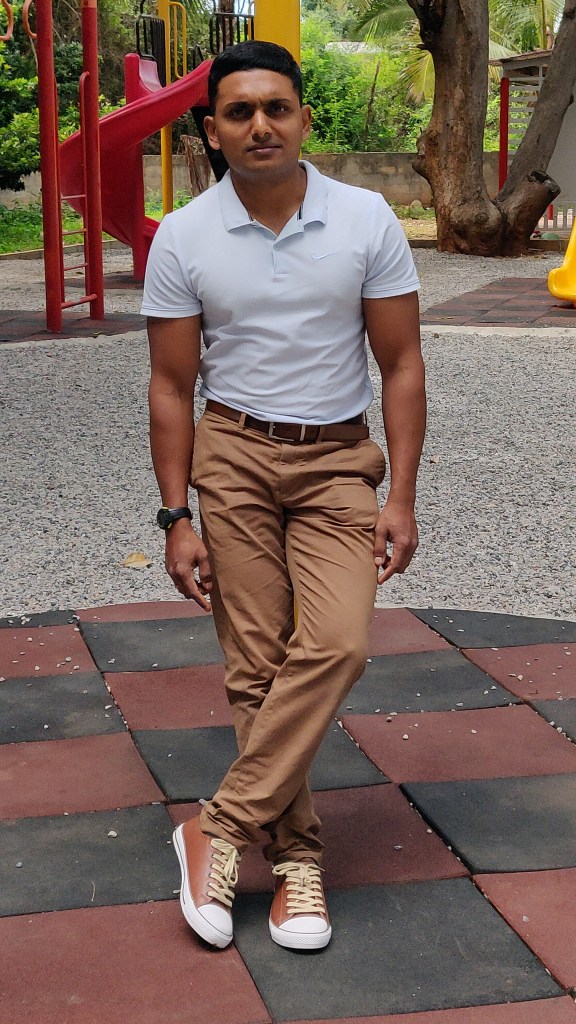
Coach Abhi is a ‘Strength Coach’ holding a Master of Physical Education and Sports Sciences (M.P.Ed NET) with a meritorious national level competency in his academic discipline. His content comes from coaching/training/learning experience of 10000 plus hours. Detailed bio here https://shakti.fitness.blog/author/
All rights reserved. Copyright © Abhijith Ravindra 
In the third episode of ಶಕ್ತಿ Shakti podcast I spoke to Ultra Runner Sandeep, a fellow Mysorean who has been running for a decade now. He is really smart, well read, a nature conservationist, and a data engineer settled in Melbourne. He speaks to us on barefoot running, his journey over the years into Ultra running, his training methods and we have a little casual chat in the end in Kannada to wind up the forty eight minutes long episode. Please listen if you want to take up ultra running. I am adding the podcast link to Spotify. Please note that it is available on SoundCloud, SPOTIFY app, and JioSaavn app on your phone – just search for ‘Shakti Podcast’ or ‘Coach Abhi’. I am yet to add all episodes here to avoid the clutter.
For those who want to register for the TCS World Open 10K – I found out from their website that online registrations will open from 8th September, 2020 on https://tcsworld10k.procam.in/
Latest Posts

The self-help predators.
The pandemic and the resulting lock-down has driven the self-help industry on a frenzy! Don’t be surprised if you are bombarded with social media advertisements of “gurus” of all avatars, speaking multiple languages with subtitles prescribing remedies to all your problems.

Understanding sports talent.
What’s the first step in making of a world champion? Readers will understand the importance of talent identification in sports.

PB – to run or not to run.
Running for a PB makes the finisher’s medal all the more special. But the fact is that one cannot get one’s PB every race. Author clarifies his dilemma while sharing some tips on giving best effort in race preparation.

Being nimble.
It is said that, “Movement is medicine.” Learn the importance of movement and the movement culture. Readers can get useful information on how to start their movement practise.
Something went wrong. Please refresh the page and/or try again.
Previous Blog Posts by Coach Abhi

 ಶಕ್ತಿ Shakti